Bernhard Karlowitz

»I am not an artist —
I moderate the emergence of something that possesses being.
In the structural act of painting—within the untamable friction between material, painter, subject, and moment. In the interaction of telling tonal values, to which I grant the gesture, I paint in the very act of experiencing. In the absolute unity of experience and the act of painting, I am the instrument of this form-giving synthesis: Art.
An intuitively alive, painterly gesture depicts encounters; it is the binding form of my painting.
I perceive my art as a radical consequence of Modernism—deeply connected to the mastery of the Italian Quattrocento and the philosophy of Greek antiquity.
As a technician, I work in the tradition of classical study and underpainting techniques. I elevate tempera painting into the full chromatic expression of the present day, without losing its austere brilliance, its poetically matte shimmer, and the delicate interplay of glazes.
My art is not predictable.
It is not decorative.
It follows no superficial aesthetics.«
Bernhard Karlowitz — Portraitist of the New Modern
Bernhard Karlowitz is an Academic Fine Artist

As a figurative painter and draftsman of New Modern, he studied Fine Arts at the Kunsthochschule Kassel within the class "New Painting (+Media)" of Prof. Rolf Lobeck.
In Kassel at the turn of the century:
within the field of tension defined by the negation of free painting, the struggle for its right to exist alongside conceptualism, a superficial painterly aesthetic, and the virtual enthusiasm of a new media epoch—amidst the shards of postmodern experiments in form-finding.
A defining guest seminar under Hans Platschek continues to determine the theoretical and painterly depth of his œuvre to this day.
The Tempera Technique for the New Modern

Karlowitz utilizes historical tempera painting in the tradition of classical underpainting, yet modified this process into a dynamic alla-prima medium for portraits in real-time sessions, figurations, and landscapes.
The artist works on the technical densification of the tempera technique into an expressively fully executed, narrative panel painting technique. Painting becomes, once again, a pictorially complex, visually self-contained event space.
Since 2014, through his engagement with the writings of Ingeborg Scheibler and Ranuccio Bianchi Bandinelli, Bernhard Karlowitz has immersed himself in the methods of ancient painting and the earth color register.
Consequently, the artist develops a sequentially structured chromatic theory of painting that detaches itself from the color wheel concept, redefining (and reclaiming) the chromatic painterly task.
The Premise of the Act of Experience

Karlowitz reclaims the premise of the unity of the painting act and the act of experience in sacred obligation, resisting in his entire œuvre the contemporary superficiality of painting, which to him becomes a mere thematic or aesthetic assertion devoid of artistic substance.
Even under the resulting near-total exclusion from the presentation, award, and funding systems of the 2000s, Karlowitz relentlessly insisted on the definitional articulation of his adherence to Classical Modernism.
He has carved out the classical sujets of art in his understanding of the search for and formulation of a New Modernism as a consistently full-time professional artist since his university diploma.
Gesture and Immediate Painting Formulate the Emphatic Level of Artistic Encounter

... and connects the painterly task into the unified genesis of painting, which as a whole becomes art through its material form, overcoming intention, subject, and classical viewer expectations.
In a collaboration with the Linden-Museum Stuttgart (State Museum of Ethnology), Karlowitz painted the dress rehearsal of the visiting Chinese music legend Xu Jiande and her accompanying Gufeng Ensemble in a real-time live session on a large-scale diptych, painted observationally directly from the audience ranks.
Karlowitz painted artist portraits that emerged from first encounters within the scheduled tight timeframes of the performers in rehearsal or lecture spaces, fully executed in single sessions.
The artist traveled as a mobile studio and operated in structurally contemporary modernity without ever visually short-circuiting the portrait as a form.
Art arises from the moment; it is encounter—even if it must be as fast as the 2000s. The portraits include, for example, the dancer and choreographer Shang-Chi Sun (Taipei/Berlin), the theater critic and publisher Peter von Becker (Berlin), and the musician and composer Daniel Schnyder (New York).
Unusual Crops and State Recognition

The painter’s composition is characterized by unusual crops and fragmentations, whereby the traditional thematic painterly task is questioned or overcome.
The background can become a thematic symbol equivalent to the subject itself—as seen in the Staatsgalerie Series of 2008/2009, which discursively reflected the tradition of the portrait,
or in the fragmented vineyard landscapes, in which the painter extracted purely abstract-painterly tasks from the subject through fragmentation, dissolving traditional thematic expectations and establishing them purely painterly-motivated within the image.
One of the central works of these multi-part landscape fragments, which feature up to 24 or more individual panels, was selected by the State of Baden-Württemberg for its permanent art collection in recognition of Bernhard Karlowitz's artistic oeuvre.
Olympia @ Home Office — Closing Accord of a Myth

In the painting Olympia at Home Office, the painter uses specific image crops and the painterly focus of the individual components to force the viewer into a conceived distance from the subject, providing the sensation of crawling along the motif, sniffing it out.
His Olympia continues the centuries-old motif passed down by painters like a torch, featuring a modern woman in a home office. Karlowitz’s Olympia is not nude, but sits across an armchair at her laptop, wearing a skirt with only her legs exposed, crossed over the armrest and waving with the stiletto heel.
Through the fragmentation of the subject, the foot episode is sexually connoted, connecting in a completely "different," contemporary manner to the Maja theme of Francisco de Goya (1746–1828) or the Olympia scandalon of Édouard Manet (1832–1883).
Karlowitz’s Olympia does not entice the viewer, nor does she expect or receive him, indeed she does not even perceive him; he can only crawl along her image, finding his counterpart in a decorative plastic dog placed in her space within her Stuttgart penthouse apartment, while a low-maintenance cactus stands by the window before the vista of the city’s rooftops.
Approaching the Oeuvre: Document and Presence
The Observational Archive — Studio Reading and Monographs
The Physical Presence — The Workspace and Real-Time Sessions
The Physical Presence — The Workspace and Real-Time Sessions
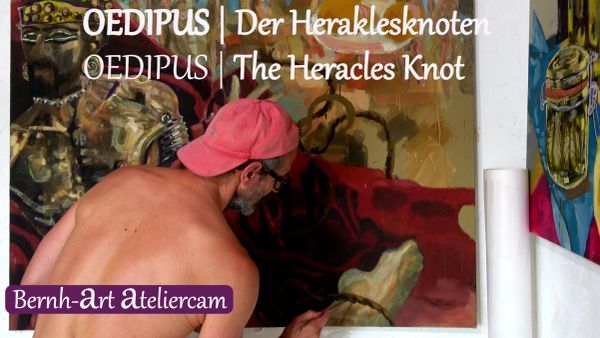
The Documentary Archive
Witness the creation of paintings or see drawings searching for their uncompromising, immediate line.
The YouTube archive documents the formal development of the Oedipus painting and the Ilias triptych.
Furthermore, the studio-cam captures the genesis of the monoinstrumental graphite series "Hecuba."
The Physical Presence — The Workspace and Real-Time Sessions
The Physical Presence — The Workspace and Real-Time Sessions
The Physical Presence — The Workspace and Real-Time Sessions

The bernh-Art Studio Gallery
is located within the private workspaces of the artist in Southwestern Germany.
This is where large-scale tempera paintings and graphic cycles emerge—and where the real-time sessions for portrait commissions take place.
Visits, studio talks, and private advance viewings of the cycles are available exclusively by prior written appointment. Please feel free to use the contact form at the bottom of this page.
Studio Bernhard Karlowitz
Güldensteinstraße 78 (Studio 1) | 74081 Heilbronn | Germany
T: 0049 (0) 7131 205247 | M: contact@bernh-art.de