The Orphic Myth: From the Exile of Drawing to the Anagnorisi
Orpheus — Reflection of the Inquiry
The Anagnorisis of the Line — The Narrative Fragment
The Anagnorisis of the Line — The Narrative Fragment
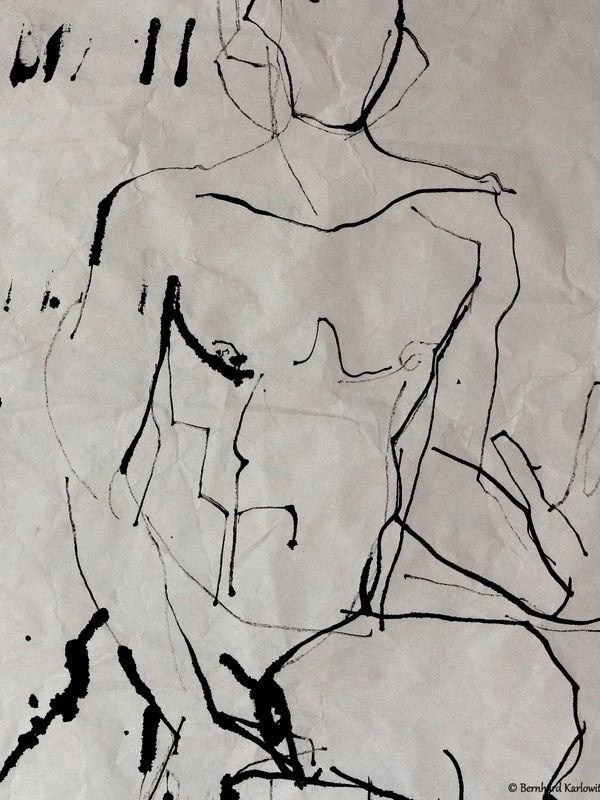
The Orphic myth constitutes one of those fragments that transitioned from the Homeric era into the philosophical reflection of Classical Greece, thereby embedding itself into the shaping consciousness of Western culture. Bernhard Karlowitz initiated his engagement with Orpheus through the reading of Thassilo von Scheffer’s translation of the Metamorphoses (Ovid — Metamorphoses, Diogenes, 1998) and was musically inspired by the crossover composition Orpheus by Manos Hatzidakis (Μάνος Χατζιδάκις)—featuring a poem by Doran Rudnytsky from his New York exile cycle Reflections of 1970—as well as by the later adaptation To Tragoudi tis Xamenis Kyriakis (Το Τραγούδι της Χαμένης Κυριακής) (The Song of a Missed Sunday), featuring a poem by Nikos Gatsos (Νίκος Γκάτσος) within the work cycle Antikatoptrismoi (Αντικατοπτρισμοί) from 1993.
The avant-garde crossover cycles Reflections and Antikatoptrismoi by the composer Hadjidakis condense the myths of antiquity into a poetic parable of a mere few lines; borne by Hadjidakis’s music, a mythically perceived fragment translates into a culturally emphatic depth that culminates or transcends the contemporary, the myth, and history itself.
Manos Hatzidakis suggested to the artist the core task: not to seek the mere illustration or narrative of the myth, but to uncover a painful, initiating, or interrogative instant that poetically rises above and abandons the myth and its variations.
Within this initial moment of fascination, Bernhard Karlowitz commenced his classical-graphic study series “Orpheus” in 2012.
The Anagnorisis of the Line — The Narrative Fragment
The Anagnorisis of the Line — The Narrative Fragment
The Anagnorisis of the Line — The Narrative Fragment

On a structural level, the Orpheus Cycle by Bernhard Karlowitz signifies his deliberate return to the medium of free drawing. It marks the radical point of departure for the artist’s search for formal graphic definition, following a twenty-year existential exile. This "exile" referenced here requires explanation:
it designates the profound consequence chosen by the young artist in 1994 to entirely abandon his most conspicuous expressive and formal talent—free drawing—yielding to the pressure of an institutional apparatus that reacted to the portfolio presentation of an aspiring art student with derision, anger, contempt, and the systematic denial of entry into the academic world.
Bernhard Karlowitz was already a gifted portraitist prior to his studies, both in linear-based draftsmanship and in structurally hatched planar drawing. Commissioned drawings and portraits by Karlowitz were already acquired during this early period; his portrait drawing of the publisher Franz Distelbarth from the 1990s was published within the prologue section of the publication The Publisher Franz Distelbarth as the frontispiece of the commemoration.
Bernhard Karlowitz compiled an application portfolio in which free artistic drawing dominated in all its facets: figurative studies, life drawings, portraits, formally linear, figurative paintings, and classical study sheets.
The academic-systemic reaction was devastating: review sessions in which the twenty-year-old was told they did not know "what the point of this was"; an irritated, from critical eyebrows accompanied flipping through or throwing of the life drawings and portraits across the room; and finally, professors' comments like:
"What do you actually imagine you are doing, cultivating such a stroke at your age?"
The Delphic Oracle in Frankfurt
The Anagnorisis of the Line — The Narrative Fragment
The Anagnorisis of the Line — The Narrative Fragment
He was encouraged to take a trip around the world instead of wanting to study art, so that "something else might occur to him." A critique professor at the Städel Academy in Frankfurt am Main became a Delphic Oracle.
It must have been Raimer Jochims. He informed him, as he helplessly flipped back and forth through the figurative, classical submission portfolio, that an application at the Städel made absolutely no sense. Even if he, by some miracle, passed the exam; no professor would accept him into his class. He—he continued—could not conceive of a single academy in all of Germany and beyond where this form would be accepted, and added: Bernhard Karlowitz would have to, if he insisted on wanting to study, seek out the individual classes of the academies independently to find a niche "where one can still do this sort of work."
The historical dimension in which the classical form of fine arts was fought against within the academic apparatus was not clear to the applicant at that time.
Ultimately, he seized upon the Delphic Oracle of Jochims and visited every academy in Germany and Austria that he could manage logistically and financially. During this time, his father went to work on foot, so that his son, with the old 123 Mercedes, year of manufacture 1976, could beleaguer the academic gates with his portfolios and demand an evaluation.
The Anagnorisis of the Line — The Narrative Fragment
The Anagnorisis of the Line — The Narrative Fragment
The Anagnorisis of the Line — The Narrative Fragment
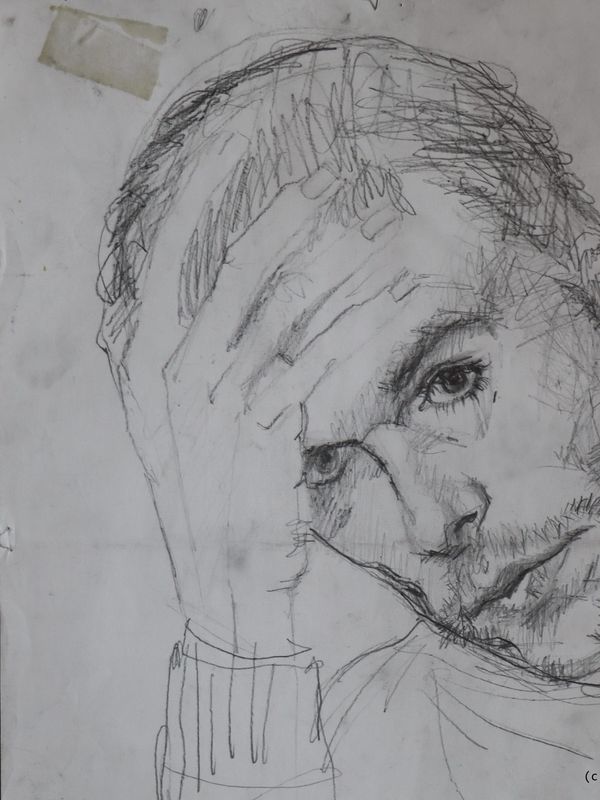
Since this was the only constructive piece of advice for the young painter after all the humiliations, he continued his inquiries at the academies in Germany and Austria.
"You won't find anyone here, the professors are all gone, it's already the semester break" — sounded in the summer of 1994 like the "end" for the rest of the season coming from the mouth of the secretary at the Kunsthochschule Kassel (Kassel Academy of Art). Perhaps, seeing the despair of the young man with the one-meter-fifty-wide corrugated cardboard portfolio held together by cut-up strips of jeans, she reconsidered, and finally added: "... at most Professor Lobeck, he's the only one who is always here... he walks around here every now and then, if you're lucky, you'll see him in the corridors somewhere. But he doesn't look like a professor, he looks like a caretaker... in case you run into him...". Bernhard Karlowitz found Lobeck in the corridor, was allowed to enter his office with his portfolio, and spread it out on the floor: "Well, at least you know how to draw."
Deeply traumatized by this admission phase, Bernhard Karlowitz nevertheless laid drawing "to rest in the archives" for two decades. Throughout his studies, he consciously chose to do exactly what he could not do and what was rightly perceived as unwieldy: a pure painting, generated entirely from the plane, devoid of linear, constructive, or graphic elements—completely relinquishing "the rescue of form" through the trained draftsman. Only color, gesture, plane. Karlowitz furthermore understood that he would never become a true painter if he did not disqualify the security of the already routined draftsman for the painter as a separate persona.
While he continuously participated in life drawing within the class of Prof. Kurt Haug, who constructively supported his work through critiques, he painted exclusively within his free studio work throughout his entire academic career.
An observation by his professor Rolf Lobeck, however, echoed for years within the independent artist, who often commented on small, graphically scribbled passages within the color abstraction: "That has something narrative about it."
Prompted by the enigmatic attraction of the musical poetry of Manos Hatzidakis, the painter resolved in 2012 to 'unearth' his untrained, unacademic, and raw youthful draftsmanship, to face the confrontation of the traumata, and to reconceive drawing with a matured feeling for art as a superior idea: to reclaim it, in order to develop it autonomously as a distinct branch of his art.
For his first major project in free drawing, he chose the unforgiving technique of kalamos drawing with brush-and-ink wash: his theme became the figuratively dynamic series Orpheus (2012).
Genesis and Myth of the Orpheus Cycle

Who is Orpheus?
The Orphic myth is imaginatively solidified within cultural memory as either a tragedy of romance or a symbol of artistic exile. These motifs pertain to the narrative structure and coloring with which we are familiar. Yet, is there another dimension of scrutiny? The point of departure for the graphic series of Bernhard Karlowitz is exclusively the raw instant of turning back. It is known that the goddess of the underworld, Demeter’s daughter Persephone, demands of Orpheus that he depart Hades without turning around even a single time—should he do so, he forfeits everything. To the critical artist, who studies himself in sudden turns and within the rapid gaze of backward motion in the mirror, two fundamental questions arise that seem largely unanalyzed in literature—as if the emerging studies themselves were interrogating him as to what they are actually executing:
The Riddle of the Condition of Persefone
1) Why does Persephone grant Orpheus the monumental favor of taking his bride Eurydice, who had perished tragically and now dwells in the realm of shadows, back into the vitality of life?
And 2) Why does she impose the relentless condition that he must never turn around on his path outward—upward—or else forfeit the gained favor and his remaining existence forever?
In the perpetual attempts of the line, which piercingly interrogate the dynamics of turning, the instantaneity of a fleeting view of motion, and the bodily language pictorially communicated through it, the painter’s thoughts tumble toward a different realization, which becomes the true point of departure for his approach to the riddle of the myth.
Excursus: Who are You? Artist & Model
Allow me a brief excursion to cultivate a deeper understanding of the artistic genesis of this graphic cycle, before we return to the enigma of Persephone’s motivation. The artist as his own model is a constant of art history that remains deeply misunderstood to this day. Observing the studies that Michelangelo drew onto the walls of his secret refuge — his existential hiding place in the basement of the Medici Chapel, one recognizes the absolute certainty of the physical imagination which he owed to the visual and tactile study of the body and a profound knowledge of the structural plane.
Is it conceivable that an artist could perpetually command an external model; that whenever an idea overcame him, he possessed immediate access to the appropriate physique?
The artist operates in view of his culturally emphatic nature, his intellect, and his physical reality as the primary reflective surface of his work. The shortest path to engagement is almost always the best—and often the only one possible.
The Naked Body of Antiquity
A retrospective reference to the dawn of the grand tradition of the human figure in antiquity clarifies that the handling of the body as a medium was a completely different, more functional one. The human of antiquity was the physical expression of philosophical and intellectual striving. The pristine sight, the functionalization, and the thematic treatment of nudity were an integral component of education itself.
The invented guilt-complex of a new, dogmatic religion sought to violently suppress this privilege of an unconstrained engagement with the human body—with this level of a philosophical observation of nature—well into our contemporary era.
In our times, an engagement with one’s own unclothed body is almost textually declared as an explicit occupation with one’s own sexuality, a breaking from the norm, or as being in the tradition of a deliberate provocation. Artists today often voluntarily choose to appear labeled as pornographic simply to preemptively evade a salacious debate regarding their actual motives.
The Misuse of the Torso
The classical artistic form of the Renaissance torso, which implies the trunk and implicitly the lower abdomen, has been simply reinterpreted within the language of a prudish history into the banal phrase "topless"—and thus entirely falsified. The artist in his self-portrait, exposed within the studio, falls under suspicion of a nonchalant, impetuous demeanor, a merely staged authentic moment—resembling those photographs of men working in the garden, which suggest that there must be morally intact reasons for this sight.
Even if some might believe that this debate has long been resolved in a free society:
the genitalia of unclothed males and females alike have been consistently—and up to this day—radically negated, marginalized, and retouched in any art that remains within conventional boundaries and refuses to break out into the aforementioned provocative matrices.
The Reclamation of Symbolic Sovereignty
The historical exception of an Egon Schiele constitutes merely the retrospectively museum-honored exception, by no means the standard societal norm. Consequently, due to this preemptive societal censorship of the debate, a naive ignorance of the topic on the part of the artist is no longer possible.
Nudity, however, is the only possible, uncorruptible symbol for man in his existential struggle for his being as such.
The apparatus's attempt to destroy this symbol has failed; even if the reclamation by artists over their own physical sovereignty is far from complete.
The gravitation that holds, bends, and conquers man constitutes the primal force against which he braces himself to fight for his own form.
The Functionality of the Instant
That Bernhard Karlowitz commenced his Orpheus studies alone in his studio before the mirror bears witness to the unplanned, unstructured entry into an obsessive thematic engagement that required nothing more than a glass of water, a bottle of ink , a kalamos pen, paper, and the best available model: which is obliged to continuously perform untamable momentum in rapid rotations.
The Sovereignty of Form
Art Dynamically Shapes, the Artist Responds
Let us return to the genesis of the artistic series and to the interrogation of Persephone, and how we interrogate her.
The expressionist series in the tradition of Oskar Kokoschka’s "O Ewigkeit, du Donnerwort" is, as already addressed in the text on the art-genesis of the Hecuba Series, an artistically investigative technique in which the individual works of the creative process determine the progression of the cycle. The significance of this observation is vehement within the context of a contemporary art that radically returns to the pre-modern procedure of the preconceived pictorial idea.
Art—rediscovered by Modernism in its definition as a process which only fulfills the definition of art through the friction of the artist with the material, the creative act, and its facets: the moment, in its psychology, in its chance, but also the pinpoint moment of realization within the creative process and the formal consequence of the modern artist in this process, which may be immensely radical or even subtle—this newly understood art and the so-defined artist, who is precisely not a mere practitioner, has been thus backward-defined in Postmodernism and in the present day through the silent reintroduction of the binding pictorial idea, of strict conceptualism, of the substantively prefabricated message that is merely "fulfilled" in this manner; it is castrated.
The painterly form, understood as an active and untamedly acting subjective element of design, becomes—particularly within the expressionist artistic series—the communicative counterpart to the moderating artist, who operates not from his plan or his idea, but passively from the "feedback" of the material, relinquishing the sovereignty of design to the form itself.

The Doubt of Orpheus

The New Orphic Question
The situational-choreographically dominated artistic discourse forces the very question that is commonly taken for granted within cultural studies. How is the decision or the impulse of Orpheus defined at the precise moment of turning back? "Why do you commit this act?" "What is the purpose?"
The Caprices of the Myth?
It is a common convention that many narrative structures of ancient myths are accepted in their bizarre appearance—in the sense of a random whim of the gods, fitting their repeatedly surprising actions and caprices. Upon closer scrutiny, however, the opportunity frequently arises to uncover a structurally meaningful narrative correspondence behind these seemingly given narrative constructs.For example: Why does the Sphinx await Oedipus on his path to Thebes and present him with the riddle of who walks on four legs in the morning, on two legs at noon, and on three legs in the evening? By Oedipus knowing the answer, he is permitted to continue his fateful path and enter Thebes.
Messages of Mythic Narrative Structure
Sophocles mirrors within this riddle the image that the entire tragedy is repeatedly thrown back upon a single realization: You are what you are. You cannot alter it. There is a destiny from which you cannot escape—just as the solution to the riddle states: "man crawls as an infant, walks on two legs as an adult, and uses a cane in old age". Sophocles also indicates multiple times in other instances that the manner in which one encounters one's destiny remains entirely up to the individual, even if one cannot escape it.
Turn around!
Orpheus simply cannot fulfill the task imposed by Persephone. He insists upon his verifying gaze. He insists upon his own, earned realization; he insists upon the sovereignty of his decision-making authority. A simple "be assured, all will be well, you do not need to verify it" not only fails to suffice for him—he cannot endure it.
He must see it for himself.
He must follow his doubt.
He insists upon his right and his duty to doubt.
Der Zweifel des Orpheus
Orpheus thus shapes the artist archetype. The myth tells us that for him, while insisting upon his premise, there is no place within society. The myth tells us that young, aspiring intellectuals seek out the nonconformist in his exile to absorb his critical thoughts, his free spirit, and his art. The myth tells us that women, acting as the symbolic guardianship of a functional society, put an end to this nonconformity, tearing Orpheus to pieces and casting him into the water to become food for the fish.
The radicalism of his insistence upon the right to doubt is punished with the most radical form of annihilation: his dismemberment and the denial of the—at that time sacred—burial, and of the chance for an existence superior to life itself.
The Archetype of the Artist
Yet the myth also tells us: Orpheus, through his uncorruptible artist's soul, could compel olive trees to follow him, so pure and beautiful was his art.
Die Anagnorisis der Symbol-Hand

The Composition
In the approximation of the square, yet within a format that deliberately evades—by a few millimeters—the perfect square, the artist forces the viewer to assume a focused, centered gaze without generating a shield-metaphor.
The bright drawing sheet is occupied by two truncations which allow the figuration to step out of the pictorial space without compromising the unity of the full figure: a portion of the foot of the standing leg and the hair spun raggedly within the turn exit the sheet at the top and bottom with a rapid velocity of stroke, thereby rupturing the pictorial space.
Through this truncation decision, the artist emphasizes the immediate urgency of the depicted instant.
The New Symbol within the Artist’s Œuvre
The center of this sheet is uniquely occupied by the artist: he introduces a symbol here which, due to the square format and the compositionally centered placement, repeatedly becomes the optical focal point: it is the open palm of the figure. It is revealed fleetingly within the rotation.
The flat, open hand is manifested thereby as a sign, as a symbol. On these sheets, Bernhard Karlowitz began for the first time to operate with the open symbolic hand, thus purposefully encoding poetic or narrative pictorial messages symbolically.
Within this phase of the work, the hand is not precisely delineated in the sense of a verbal meaning. Nor is it occupied in reminiscence of familiar symbol-linguistic elements of art history. At this point of his figurative work, it is rather created within the artist’s oeuvre as an autonomously developed symbol.
Within the context of the depiction, Karlowitz's hand-symbol can signify both "guilt" and "innocence," or the presentation of "I am innocent" or "I am guilty." It can equally signify, within its gesture and chromatic execution, the interrogation of guilt or innocence, or the pinpoint moment of realization of this reflection.
As a cultural-symbolic gesture, one could link it to the stance: "I am peaceful," "I am unarmed."
The symbol, which was to become the central metaphor in many of the artist's figurative works, is here, still within the form-process of the symbol-linguistic creation, placed directly from the gesture, operating within the suspension of the turning momentum captured graphically via washes, appearing almost like a proud ornament being held and shown.
The Center of the Cycle
Orpheus thus reflects, within his decision to pursue the persona of the artist, the question regarding the consequence of its mythic punishment. This central work of the series also features an expression of the gaze within the moment of recognition that is clearly formulated, despite being cast in seconds via gestural washes.
Within a shadow-overlay structured against the light, the expression does not appear obvious, but is submerged into an instant of riddle. Orpheus seems not ostensibly aggressive, not despondent, not resolute, or even liberated as he executes the decisive turning point of his being.
It appears rather to be the expression of this resolutely executed turning back itself, which is performed reflectively, fully comprehending the gravity of his choice to violate Persephone’s law.
The Planar Tectonics of the Gesture — The Hour of the New Technique
Bernhard Karlowitz reclaims the tradition of the washed pen drawing in its significance as a rapidly executed technique, by which it became a travel medium, the painter's notebook; deployed by applied painters certainly also for the sake of aesthetic charm.
The artist perceives the kalamos not as an Asian instrument of the essence-reflecting, aesthetic sign, but as a rhythmic striking instrument; yet he deploys his security—trained over decades—to melodiously modulate figurative nuances within the stroke-impact, so that his style nevertheless stands within the figuratively-expressively binding tradition.
Karlowitz, however, ruptures the aesthetic tradition of form within his return to drawing:
The washed plane is not an airy, charmingly applied accidence to the aesthetic line—the shaping sovereignty of the painterly arm, of the painter's instinct for backlit, diffusely subtle surfaces directs the technical-graphic formal language of tradition into the planar-tectonic law of painting.
The consequence of the draftsman’s exile—which would have otherwise suppressed the evolution of the painter through his sheer dominance—now allows painting as a core conception to collide with primal force against the old sovereignty of the draftsman, generating an artistic-expressive form that—in this manner—refers to no historical tradition or reference whatsoever.
Inherent Material Specifications:
- Short Description: Full figure in rear-side view, rotation of the upper body toward the front.
- Signatures: Inscribed with "BK" and "BKarlowitz", as well as the handwritten dating: "6/7 12".
- Dating: July 6, 2012.
- Dimensions: 34.9 x 33.3 cm (sheet size).
- Materiality & Tools: White drawing paper, ink (Rohrer's drawing ink, sepia/umber), water. Guided with large, flat goat-hair tempera brushes with a blade width of approx. 4.5 cm, gripped fully by the hand and moved across the edge or with the corner.